Non-Implementation Reports
Non-Implementation Reports
European Governments Ignore Binding Court Rulings: A Systemic Rule of Law Issue - Report
When courts speak, do governments listen?
What happens when governments ignore the rulings of Europe’s highest courts? For thousands of citizens across the EU, the answer is a persistent denial of justice and a weakening of the rule of law that underpins our democracies. Since 2022, Democracy Reporting International and the European Implementation Network have jointly tracked how EU Member States implement the judgments of the European Court of Human Rights and the Court of Justice of the EU in an annual report: ‘Justice Delayed and Justice Denied’.
Our findings consistently reveal a systemic failure: EU member states are leaving binding judgments from the European Court of Human Rights (ECtHR) and the Court of Justice of the EU (CJEU) unimplemented for years, allowing human rights violations and rule of law infringements to continue and eroding public trust in these institutions.
A system under strain: The 2025 Report
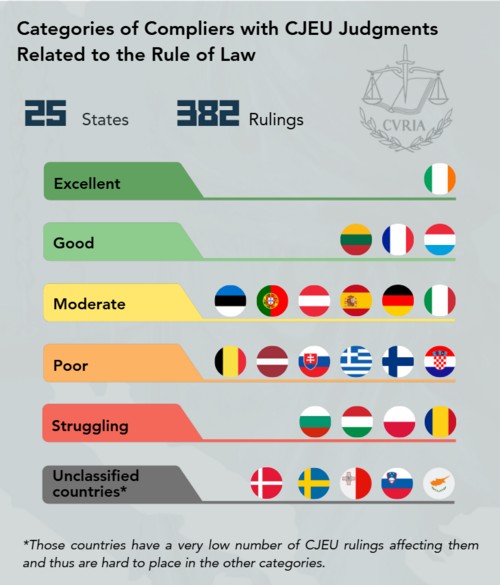
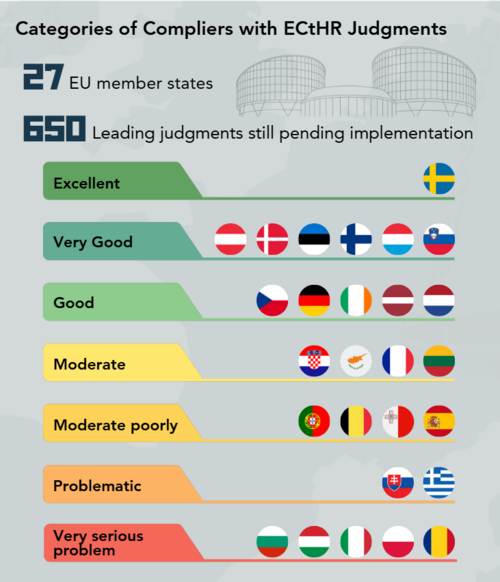
The fourth edition of Justice Delayed and Justice Denied examines 382 CJEU rulings and 650 ECtHR rulings, exposing a pattern of delay, partial compliance, and, in some cases, outright defiance. Certain member States routinely leave judgments from European courts unimplemented for years; non-compliance is increasingly accompanied by open or implicit contestation of European courts’ authority by political actors and, at times, by top national courts.
*Assessments on the ECtHR valid as of 1 January 2025 and CJEU data as of 1 May 2025
Court of Justice of the European Union
- Of the 382 rulings issued between 1 January 2019 and 1 January 2025, only 223 (58.4%) have been fully complied with.
- More than one third - 133 in total – remain unresolved. 98 (25.6% of all rulings) have been only partly complied with, while 35 (9%) - not at all.
- Of these unresolved rulings, 84 (63.15 %) have been pending for over two years with critical institutional reforms addressing systemic issues delayed, stalled or effectively sidestepped.
- Compliance problems are most acute in Bulgaria and Hungary, where 52.94% and 84.6%, respectively, of ‘not-complied-with' rulings have been pending for over two years.
- Poland and Romania fall within the “problematic complier” category, due to prolonged delays in justice-sector reforms.
- Belgium demonstrates poor compliance, with 11 rulings—91.7% of its outstanding cases—pending for two years or longer.
- Delays are also evident in several moderate compliers, including Portugal, Austria and Italy, where implementation has stalled in specific areas.
European Court of Human Rights (ECtHR)
- As of January 2025, 650 leading judgments remain unimplemented.
- 45.7% of leading judgments delivered over the past decade are still pending.
- Hungary continues to have the highest rate of leading ECtHR rulings rendered in the last ten years still awaiting implementation (74 %).
- Romania remains the state with the highest number of pending leading judgements, 111 still unimplemented.
- The average implementation time for leading judgments stands at 5 years and 4 months. Several countries show significantly longer delays — exceeding 12 years in some cases— including Bulgaria, Hungary, Italy, Poland and Romania, all of which are among problematic compliers.
- In 2024, these five jurisdictions continued to perform the worst. The implementation record of several other states (e.g. Portugal and Slovakia) has deteriorated. On the other hand, a few have shown improvement, including Austria, Cyprus, and Germany, as well as Finland, which has nearly eliminated its longstanding backlog.
A Decade of declining compliance: The 2024 Report
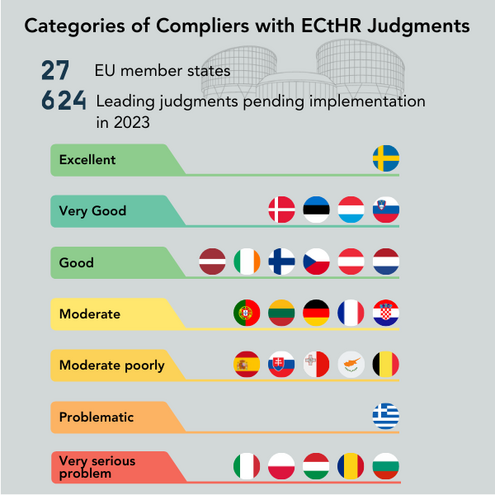
In 2024, a total of 624 ECtHR judgments were pending, rising from 616 in 2022 and 602 in 2021. Meanwhile, the time it takes to implement rulings kept growing too:
- 2023: 5 years and 2 months
- 2022: 5 years and 1 month
- 2021: 4 years and 4 months
In 2024, of 201 rule of law related rulings followed up, 71 showed clear evidence of no or only partial compliance. Of those 71, over 60% (43 rulings) had been pending compliance for two years or longer.
As of 1 May 2025, only 5 of those 71 rulings have progressed to full compliance since the 2024 assessment. The remaining 66 continue to be only partially complied with or not complied with at all.
This rising backlog highlights a growing challenge in the enforcement of critical rulings designed to protect fundamental rights across Europe. Behind these numbers are real consequences: citizens denied redress, rights left unprotected, and democratic institutions undermined.

Every unimplemented judgment represents a broken promise to victims of rights violations, to the integrity of EU law, and to the principle that no one is above the law. As the CJEU increasingly tackles rule of law issues, the stakes couldn’t be higher.
Explore our reports to see how compliance has evolved across Europe and what steps countries are taking to address the challenges.