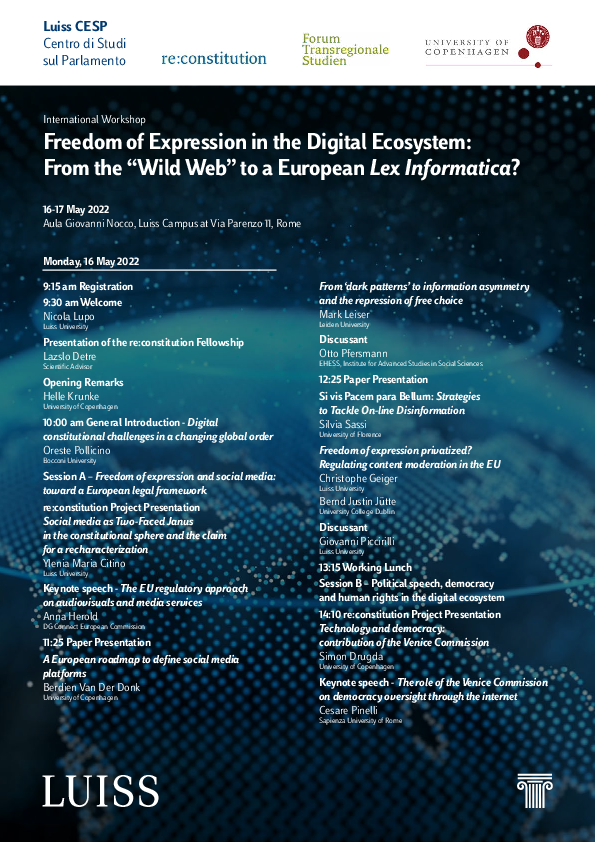
Since its beginning, the Internet has been seen as an anarchically free environment, mostly spontaneously regulated. In the U.S., both the case law of the Courts and the federal legislation confirmed a legal framework that prioritized liberty over responsibility. In Europe, a different set of principles took shape, mainly through the contribution of the judicial branches of the individual countries and the Council of Europe. As a consequence, in recent years, we have witnessed the framing of community standards and self-regulations by companies whose main goal is to avoid a situation in which lack of rules renders them liable. These regulations have often proven ineffective, as they have endowed algorithms and private entities with the authority to manage dilemmatic conflicts that involve the balance between fundamental rights, human dignity, and freedom of speech in public arena. This has led to a regulatory drive, especially in the area of free speech, elections and democracy. This necessity is even more stressed in a context in which the power of private digital services providers is increased by the oligopolistic dimensions of the market. Nowadays, the speed at which technological innovation take place and the cross-border dimension of it calls for a European supranational regulatory approach: the goal of a ‘lex informatica’ emerges, to assist the citizens in the legal issues, much as the ‘lex mercatoria’ favored trade between the merchants in the past. The state of play of European common actions, aiming at fixing the main aspects of the virtual infrastructure, consists of a package of disciplines – or proposed disciplines – that wipe out overlapping, inefficient or simply conflicting regulations to ensure a level playing field framework. See, for example, the challenges being addressed by the proposed Digital Services Act and Digital Market Act regulations.